 |
OWLNext 7.0
Borland's Object Windows Library for the modern age
|
|
OWLNext 7.0
Borland's Object Windows Library for the modern age
|
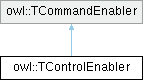
A TCommandEnabler for child controls in a dialog. More...
#include <owl/dialog.h>
Public Member Functions | |
| TControlEnabler (uint id, HWND hWndReceiver=0) | |
| Constructor. Initializes the base class. | |
| void | Enable (bool enable=true) |
| Enables/disables the control. | |
| void | SetText (LPCTSTR text) |
| Set the text of the control. | |
| void | SetCheck (int check) |
| Use with only buttons! | |
| virtual void | SetText (LPCTSTR text)=0 |
| Changes the text associated with a command sender; for example, text associated with a menu item or text on a button. | |
| void | SetText (const tstring &s) |
 Public Member Functions inherited from owl::TCommandEnabler Public Member Functions inherited from owl::TCommandEnabler | |
| TCommandEnabler (uint id, HWND hWndReceiver=0) | |
| Constructs the TCommandEnabler object with the specified command ID. | |
| uint | GetId () const |
| Retrieves the id of the command. | |
| void | SetText (const tstring &s) |
| void | SetCheck (bool isChecked) |
| Overload; allows you to pass a bool safely. | |
| bool | SendsCommand () const |
| Returns true if this command enabler sends a command message. | |
| bool | GetHandled () |
| Return true if the command enabler has been handled. | |
| bool | IsReceiver (HWND hReceiver) |
| Returns true if receiver is the same as the message responder originally set up in the constructor. | |
| HWND | GetReceiver () const |
| Returns the handle of the window that this enabler was destined for. | |
| void | SetReceiver (HWND hReceiver) |
| Sets the receiver for the enabler. | |
Additional Inherited Members | |
| Public Types inherited from owl::TCommandEnabler | |
| enum | TCommandState { Unchecked , Checked , Indeterminate } |
| Enumeration describing the 3-states or availability of a command. More... | |
| Protected Types inherited from owl::TCommandEnabler | |
| enum | TCommandStatus { WasHandled = 1 , NonSender = 2 } |
| Enumeration describing whether the associated command has been enabled or disabled, and whether the command generates WM_COMMAND messages. More... | |
| Protected Member Functions inherited from owl::TCommandEnabler | |
| void | SetHandled () |
| Marks that the enabler has been handled. | |
| Protected Attributes inherited from owl::TCommandEnabler | |
| uint | Flags |
| TCommandStatus flags Is TCommandStatus::WasHandled if the command enabler has been handled. | |
| DECLARE_CASTABLE | |
A TCommandEnabler for child controls in a dialog.
Constructor. Initializes the base class.
Definition at line 950 of file dialog.cpp.
Enables/disables the control.
Reimplemented from owl::TCommandEnabler.
Definition at line 960 of file dialog.cpp.
References owl::TCommandEnabler::Enable(), owl::TCommandEnabler::GetReceiver(), and owl::ToBool().
Use with only buttons!
Implements owl::TCommandEnabler.
Definition at line 983 of file dialog.cpp.
References owl::TCommandEnabler::GetReceiver().
Set the text of the control.
Implements owl::TCommandEnabler.
Definition at line 971 of file dialog.cpp.
References _tcscmp, owl::TCommandEnabler::GetReceiver(), and MAX_PATH.
Changes the text associated with a command sender; for example, text associated with a menu item or text on a button.
Implements owl::TCommandEnabler.
 1.10.0