 |
OWLNext 7.0
Borland's Object Windows Library for the modern age
|
|
OWLNext 7.0
Borland's Object Windows Library for the modern age
|
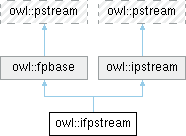
ifpstream is a simple "mix" of its bases, fpbase and ipstream. More...
#include <owl/objstrm.h>
Public Member Functions | |
| ifpstream () | |
| Creates a buffered ifpstream object using a default buffer. | |
| ifpstream (LPCSTR, int=std::ios::in, int=fpbase::openprot) | |
| Creates a buffered ifpstream object. | |
| ifpstream (LPCWSTR, int=std::ios::in, int=fpbase::openprot) | |
| Creates a buffered ifpstream object. | |
| std::filebuf * | rdbuf () |
| Returns a pointer to the current file buffer. | |
| void | open (LPCSTR, int=std::ios::in, int=fpbase::openprot) |
| It opens the named file in the given mode (app, ate, in, out, binary, trunc, nocreate, or noreplace) and protection. | |
| void | open (LPCWSTR, int=std::ios::in, int=fpbase::openprot) |
| It opens the named file in the given mode (app, ate, in, out, binary, trunc, nocreate, or noreplace) and protection. | |
 Public Member Functions inherited from owl::fpbase Public Member Functions inherited from owl::fpbase | |
| fpbase () | |
| Creates a buffered fpbase object. | |
| fpbase (LPCSTR, int, int=openprot) | |
| Creates a buffered fpbase object. | |
| fpbase (LPCWSTR, int, int=openprot) | |
| Creates a buffered fpbase object. | |
| void | open (LPCSTR, int, int=openprot) |
| Opens the named file in the given mode (app, ate, in, out, binary, trunc, nocreate, or noreplace) and protection. | |
| void | open (LPCWSTR, int, int=openprot) |
| Opens the named file in the given mode (app, ate, in, out, binary, trunc, nocreate, or noreplace) and protection. | |
| void | close () |
| Closes the stream and associated file. | |
| void | setbuf (LPSTR, int) |
| Sets the location of the buffer to buf and the buffer size to len. | |
| std::filebuf * | rdbuf () |
| Returns a pointer to the current file buffer. | |
| Public Member Functions inherited from owl::pstream | |
| pstream (std::streambuf *) | |
| Creates a buffered pstream with the given buffer. The state is set to 0. | |
| virtual | ~pstream () |
| int | rdstate () const |
| Returns the current state value. | |
| int | eof () const |
| Returns nonzero on end of stream. | |
| int | fail () const |
| Returns nonzero if a previous stream operation failed. | |
| int | bad () const |
| Returns nonzero if an error occurs. | |
| int | good () const |
| Returns nonzero if no error states have been recorded for the stream (that is, no errors have occurred). | |
| void | clear (int=0) |
| Sets the stream state to the given value (defaults to 0). | |
| operator void * () const | |
| Converts to a void pointer. | |
| int | operator! () const |
| Overloads the NOT operator. | |
| std::streambuf * | rdbuf () const |
| Returns the pb pointer to the buffer assigned to the stream. | |
| Public Member Functions inherited from owl::ipstream | |
| ipstream (std::streambuf *) | |
| Creates a buffered ipstream with the given buffer. The state is set to 0. | |
| std::streampos | tellg () |
| Returns the (absolute) current stream position. | |
| ipstream & | seekg (std::streampos) |
| ipstream & | seekg (std::streamoff, std::ios::seekdir) |
| uint8 | readByte () |
| Returns the byte at the current stream position. | |
| void | readBytes (void *, size_t) |
| Reads sz bytes from current stream position, and writes them to data. | |
| void | freadBytes (void *data, size_t sz) |
| Reads the number of bytes specified by sz into the supplied buffer (data). | |
| uint32 | readWord () |
| Returns the word at the current stream position. | |
| uint16 | readWord16 () |
| Returns the 16-bit word at the current stream position. | |
| uint32 | readWord32 () |
| Returns the 32-bit word at the current stream position. | |
| LPSTR | readString () |
| Allocates a buffer large enough to contain the string at the current stream position and reads the string into the buffer. | |
| LPSTR | readString (LPSTR, unsigned) |
| Reads the string at the current stream position into the buffer specified by buf. | |
| char * | freadString () |
| Reads a string from the stream. | |
| char * | freadString (char *buf, unsigned maxLen) |
| Reads a string from the stream into the supplied far buffer (buf). | |
| uint32 | getVersion () const |
| Returns the object version number. | |
| TStreamableBase * | readObject (TStreamableBase *&mem, ModuleId mid=GetModuleId()) |
| TStreamableBase * | readObjectPointer (TStreamableBase *&mem, ModuleId mid=GetModuleId()) |
| TStreamableBase * | find (P_id_type) |
| Returns a pointer to the object corresponding to Id. | |
| void | registerObject (TStreamableBase *adr) |
| Registers the object pointed to by adr. | |
Additional Inherited Members | |
| Public Types inherited from owl::fpbase | |
| enum | { openprot = 0666 } |
| Public Types inherited from owl::pstream | |
| enum | PointerTypes { ptNull , ptIndexed , ptObject } |
| Enumerates object pointer types. More... | |
| Protected Member Functions inherited from owl::pstream | |
| pstream () | |
| Creates a pstream without initializing the buffer pointer bp or state. | |
| void | init (std::streambuf *) |
| The init member function initializes the stream and sets state to 0 and bp to sbp. | |
| void | setstate (int) |
| Updates the state data member with state |= (b & 0xFF). | |
| Protected Member Functions inherited from owl::ipstream | |
| ipstream () | |
| Creates a buffered ipstream without initializing the buffer pointer, bp. | |
| const ObjectBuilder * | readPrefix (ModuleId mid) |
| Returns the TStreamableClass object corresponding to the class name stored at the current position in the stream. | |
| void | readData (const ObjectBuilder *, TStreamableBase *&) |
| If mem is 0, it calls the appropriate build function to allocate memory and initialize the virtual table pointer for the object. | |
| void | readSuffix () |
| Reads and checks the suffix of the object. | |
| void | readVersion () |
| Reads the version number of the input stream. | |
| Protected Attributes inherited from owl::pstream | |
| std::streambuf * | bp |
| int | state |
ifpstream is a simple "mix" of its bases, fpbase and ipstream.
Base class for reading streamable objects from file streams.
It provides the base class reading (extracting) streamable objects from file streams.
 1.10.0