 |
OWLNext 7.0
Borland's Object Windows Library for the modern age
|
|
OWLNext 7.0
Borland's Object Windows Library for the modern age
|
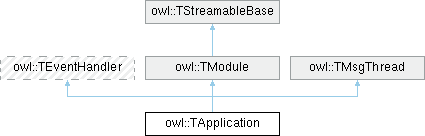
Derived from TModule and TMsgThread and virtually derived from TEventHandler, TApplication acts as an object-oriented stand-in for an application module. More...
#include <owl/applicat.h>
Public Member Functions | |
| TApplication (LPCTSTR name=nullptr, TModule *&=owl::Module, TAppDictionary *=nullptr) | |
| Constructor for use in OwlMain(). | |
| TApplication (const tstring &name, TModule *&=owl::Module, TAppDictionary *=nullptr) | |
| String-aware overload. | |
| TApplication (LPCTSTR name, HINSTANCE hInstance, HINSTANCE hPrevInstance, const tstring &cmdLine, int cmdShow, TModule *&=owl::Module, TAppDictionary *=nullptr) | |
| Constructor for use in user defined WinMain() when all the args are available. | |
| TApplication (const tstring &name, HINSTANCE hInstance, HINSTANCE hPrevInstance, const tstring &cmdLine, int cmdShow, TModule *&=owl::Module, TAppDictionary *=nullptr) | |
| String-aware overload. | |
| ~TApplication () override | |
| ~TApplication destroys the TApplication object. | |
| TFrameWindow * | GetMainWindow () |
| Return the current main window. | |
| TDocManager * | GetDocManager () |
| Return the current document manager. | |
| TLangId | GetLangId () const |
| Returns identifier of language used by application. | |
| void | SetLangId (TLangId landid) |
| Sets new language for use with application. | |
| void | ClearMainWindow () |
| Called by the main window (TFrameWindow) destructor to zero the MainWindow member. | |
| void | GetWinMainParams () |
| Retrieve the WinMain parameters. | |
| HINSTANCE | GetPrevInstance () const |
| Return the HINSTANCE of the previous running instance. | |
| void | SetPrevInstance (HINSTANCE pi) |
| Set the previous instance. | |
| int | GetCmdShow () const |
| Retrieve the initial state of the main window. | |
| void | SetCmdShow (int cmdshow) |
| Sets the initial state of the main window. | |
| TCurrentEvent & | GetCurrentEvent () |
| Return the current event from the message queue. | |
| virtual bool | CanClose () |
| Determine whether the application can be closed. | |
| auto | Run () -> int override |
| Run this application, return when application terminates. | |
| virtual int | Start () noexcept |
| Start this application and return immediately. Used for component DLLs. | |
| virtual void | WaitOnObject (HANDLE handle, bool wait) |
| virtual void | ObjectSignaled (HANDLE, bool) |
| TWindow * | GetWindowPtr (HWND hWnd) const |
| Get the TWindow pointer belonging to this app given an hWnd. | |
| void | PostDispatchAction () |
| Call this function after each msg dispatch if TApplication's message loop is not used. | |
| int | MessageBox (HWND wnd, const tstring &text, const tstring &caption=tstring(), uint type=MB_OK) const |
| virtual int | MessageBox (HWND wnd, LPCTSTR text, LPCTSTR caption=nullptr, uint type=MB_OK) const |
| Open a modal message box, Under WIN32 the language id setting is used. | |
| virtual TTooltip * | GetTooltip () const |
| Get Tooltip. | |
| virtual void | EnableTooltip (bool enable=true) |
Message queue loop & response functions | |
| auto | MessageLoop () -> int override |
| Operates the application's message loop, which runs during the lifetime of the application. | |
| auto | IdleAction (long idleCount) -> bool override |
| Called each time there are no messages in the queue. | |
| auto | ProcessMsg (MSG &) -> bool override |
| Called for each message that is pulled from the queue, to perform all translation & dispatching. | |
| virtual bool | ProcessAppMsg (MSG &msg) |
| Called after each message is pulled from the queue, and before it is dispatched. | |
Exception propagation mechanism | |
| void | SuspendThrow (std::exception_ptr) |
| Stores the given exception so that it can be rethrown later by a call to ResumeThrow. | |
| void | ResumeThrow () |
| Rethrows the suspended exception stored by a previous call to SuspendThrow. | |
| bool | HasSuspendedException () const |
Begin and end of a modal window's modal message loop | |
| int | BeginModal (TWindow *window, int flags=MB_APPLMODAL) |
| Called to begin a modal window's modal message loop. | |
| void | EndModal (int result) |
| Cause the current modal message loop to break and have it return a result Re-enable the disabled windows here, if the EnumInfo is available. | |
| virtual void | PreProcessMenu (HMENU hMenubar) |
| Called by the main window to provide an oportunity to preprocess the main window's menubar before it is installed. | |
Dead TWindow garbage collection | |
| void | Condemn (TWindow *win) |
| Condemns the given window to be deleted the at the next available safe time. | |
| void | Uncondemn (TWindow *win) |
| Removes the given window from the list of condemned windows. | |
TEventHandler overrides | |
| auto | Find (TEventInfo &, TEqualOperator=nullptr) -> bool override |
| Overrides TEventHandler::Find. | |
 Public Member Functions inherited from owl::TEventHandler Public Member Functions inherited from owl::TEventHandler | |
| TResult | Dispatch (TEventInfo &info, TParam1, TParam2=0) |
| Takes the message data from TEventInfo's Msg data member and dispatches it to the correct event-handling function. | |
| TResult | DispatchMsg (TMsgId, uint id, TParam1, TParam2) |
| Search for the event given the message and it and dispatch to the event handler if found. | |
| Public Member Functions inherited from owl::TModule | |
| TModule (const tstring &name, bool shouldLoad=true, bool mustLoad=true, bool addToList=true) | |
| Constructs a TModule object that is used as an alias for a DLL. | |
| TModule (LPCTSTR name, THandle handle, bool addToList=true) | |
| Constructs a TModule object that is an alias for an already loaded DLL or program with an available HInstance. | |
| TModule (const tstring &name, THandle handle, bool addToList=true) | |
| String-aware overload. | |
| TModule (LPCTSTR name, THandle handle, const tstring &cmdLine, bool addToList=true) | |
| Constructs a TModule object for an ObjectWindows DLL or program from within LibMain or WinMain. | |
| TModule (const tstring &name, THandle handle, const tstring &cmdLine, bool addToList=true) | |
| String-aware overload. | |
| virtual | ~TModule () |
| Destructs a TModule, freeing the instance if appropriate, and deleting new'd strings. | |
| void | InitModule (THandle handle, const tstring &cmdLine) |
| Finish-up initialization of a module. | |
| virtual int | Error (TXBase &x, uint captionResId, uint promptResId=0) |
| Replaceable exception handler; may be redefined to process OWL exceptions if canResume is false, then the user doesn't have the option of ignoring. | |
| LPCTSTR | GetName () const |
| Returns the name of the module. | |
| void | SetName (LPCTSTR name) |
| Accessor function that sets the name of the module. | |
| void | SetName (const tstring &name) |
| String-aware overload. | |
| THandle | GetHandle () const |
| Return the instance handle of the library module represented by the TModule obect. | |
| operator THandle () const | |
| Returns the handle of the application or DLL module represented by this TModule. | |
| bool | operator== (const TModule &m) const |
| Returns true if this instance is equal to the other instance; otherwise, returns false. | |
| bool | IsLoaded () const |
| Returns a nonzero value if the instance handle is loaded. | |
| int | GetModuleFileName (TCHAR *buff, int maxChars) const |
| Returns the expanded file name (path and file name) of the file from which this module was loaded. | |
| tstring | GetModuleFileName () const |
| String-aware overload. | |
| FARPROC | GetProcAddress (TNarrowResId) const |
| Returns the entry-point address of the specified exported function if found, otherwise returns NULL. | |
| HRSRC | FindResource (TResId id, TResId type) const |
| Wrapper for the Windows API to find a particular resource. | |
| HRSRC | FindResourceEx (TResId id, TResId type, TLangId langId=LangNeutral) const |
| Wrapper for the Windows API to find a particular resource. | |
| HGLOBAL | LoadResource (HRSRC hRsrc) const |
| Wrapper for the Windows API. | |
| uint32 | SizeofResource (HRSRC hRsrc) const |
| Wrapper for the Windows API. | |
| int | LoadString (uint id, TCHAR *buf, int maxChars) const |
| Loads a string resource identified by id into the buffer pointed to by buff. | |
| tstring | LoadString (uint id) const |
| Loads a string resource identified by id. | |
| HBITMAP | LoadBitmap (TResId id) const |
| Wrapper for the Windows API. | |
| HACCEL | LoadAccelerators (TResId id) const |
| Wrapper for the Windows API. | |
| HMENU | LoadMenu (TResId id) const |
| Wrapper for the Windows API. | |
| HCURSOR | LoadCursor (TResId id) const |
| Wrapper for the Windows API. | |
| HICON | LoadIcon (TResId name) const |
| Wrapper for the Windows API. | |
| std::string | LoadHtml (TResId) const |
| Loads the given HTML resource and returns it as a narrow string. | |
| HICON | CopyIcon (HICON hIcon) const |
| Wrapper for the Windows API. | |
| auto | GetClassInfo (TWindowClassName, WNDCLASS *wndclass) const -> bool |
| Retrieves information about the given window class. | |
| auto | GetClassInfo (TWindowClassName) const -> WNDCLASS |
| Functional-style overload. | |
| auto | IsRegisteredClass (TWindowClassName) const -> bool |
Returns true if the given window class has been registered. | |
| Public Member Functions inherited from owl::TStreamableBase | |
| virtual | ~TStreamableBase () |
| Public Member Functions inherited from owl::TMsgThread | |
| TMsgThread (TCurrent) | |
| Attaches to the current running thread. | |
| bool | PumpWaitingMessages () |
| The inner message loop. | |
| void | FlushQueue () |
| Flushes all real messages from the message queue. | |
| bool | IsRunning () const |
| Is this queue thread running its message loop? | |
Static Public Member Functions | |
| static void | SetWinMainParams (HINSTANCE hInstance, HINSTANCE hPrevInstance, const tstring &cmdLine, int cmdShow) |
| Set the data members with data from WinMain. | |
| static tstring & | GetCmdLine () |
| Return the command line of the application. | |
| Static Public Member Functions inherited from owl::TModule | |
| static TModule * | FindResModule (TResId id, TResId type) |
| Global search for resources. | |
| static TModule * | NextModule (TModule *module=nullptr) |
Protected Member Functions | |
| virtual void | InitApplication () |
| Handle initialization for the first executing instance of the OWL application. | |
| void | InitInstance () override |
| Performs each instance initialization necessary for the application. | |
| virtual void | InitMainWindow () |
| Initialize the application's main window. | |
| auto | TermInstance (int status) -> int override |
| Handle termination for each executing instance of the application. | |
| void | SetTooltip (TTooltip *tooltip) |
| Assigns tooltip. | |
| TFrameWindow * | SetMainWindow (TFrameWindow *window) |
| Set (or reset) the main window. | |
| auto | SetMainWindow (std::unique_ptr< TFrameWindow >) -> std::unique_ptr< TFrameWindow > |
| Smart-pointer-aware overload. | |
| TDocManager * | SetDocManager (TDocManager *docManager) |
| Set (or resets) the document manager, return the previous one if present. | |
| auto | SetDocManager (std::unique_ptr< TDocManager >) -> std::unique_ptr< TDocManager > |
| Smart-pointer-aware overload. | |
| Protected Member Functions inherited from owl::TEventHandler | |
| bool | SearchEntries (const TGenericTableEntry *entries, TEventInfo &info, TEqualOperator op) |
| Low-level response table search function. | |
| Protected Member Functions inherited from owl::TModule | |
| void | SetHandle (THandle handle) |
| Set the module instance handle. | |
Additional Inherited Members | |
| Public Types inherited from owl::TEventHandler | |
| typedef bool(* | TEqualOperator) (const TGenericTableEntry &, const TEventInfo &) |
| Public Types inherited from owl::TModule | |
| typedef HINSTANCE | THandle |
| TModule encapsulates an HINSTANCE. | |
| Public Types inherited from owl::TMsgThread | |
| enum | TCurrent { Current } |
| Protected Attributes inherited from owl::TMsgThread | |
| bool | BreakMessageLoop |
| Message loop is broken via WM_QUIT. | |
| int | MessageLoopResult |
| Return value from message loop. | |
| bool | LoopRunning |
| Track if the loop is running. | |
Derived from TModule and TMsgThread and virtually derived from TEventHandler, TApplication acts as an object-oriented stand-in for an application module.
TApplication and TModule supply the basic behavior required of an application. TApplication member functions create instances of a class, create main windows, and process messages.
To create an OLE-enabled Doc/View application, you need to derive your application from both TApplication and TOcAppHost.
Definition at line 138 of file applicat.h.
| owl::TApplication::TApplication | ( | LPCTSTR | name = nullptr, |
| TModule *& | module = owl::Module, | ||
| TAppDictionary * | appDict = nullptr ) |
Constructor for use in OwlMain().
Gets members from statics set earlier by a call to InitWinMainParams() in Owl's WinMain. Creates a new TApplication object named name. You can use owl::Module to specify the global module pointer that points to this application. The appDict parameter specifies which dictionary this application will insert itself into. To override the default ObjectWindows TAppDictionary object, pass a pointer to a user-supplied appDict object.
Definition at line 288 of file applicat.cpp.
References _T, owl::TAppDictionary::Add(), owl::LangUserDefault, OWL_CDLEVEL, owl::OWLGetAppDictionary(), and TRACEX.
| owl::TApplication::TApplication | ( | const tstring & | name, |
| TModule *& | module = owl::Module, | ||
| TAppDictionary * | appDict = nullptr ) |
String-aware overload.
Definition at line 324 of file applicat.cpp.
References _T, owl::TAppDictionary::Add(), OWL_CDLEVEL, and TRACEX.
| owl::TApplication::TApplication | ( | LPCTSTR | name, |
| HINSTANCE | instance, | ||
| HINSTANCE | prevInstance, | ||
| const tstring & | cmdLine, | ||
| int | cmdShow, | ||
| TModule *& | module = owl::Module, | ||
| TAppDictionary * | appDict = nullptr ) |
Constructor for use in user defined WinMain() when all the args are available.
Creates a TApplication object with the application name (name), the application instance handle (instance), the previous application instance handle (prevInstance), the command line invoked (cmdLine), and the main window show flag (cmdShow). The appDict parameter specifies which dictionary this application will insert itself into. To override the default ObjectWindows TAppDictionary object, pass a pointer to a user-supplied appDict object.
If you want to create your own WinMain, use this constructor because it provides access to the various arguments provided by WinMain. You can use module to to specify the global module pointer that points to this application.
Definition at line 372 of file applicat.cpp.
References _T, owl::TAppDictionary::Add(), OWL_CDLEVEL, and TRACEX.
| owl::TApplication::TApplication | ( | const tstring & | name, |
| HINSTANCE | hInstance, | ||
| HINSTANCE | hPrevInstance, | ||
| const tstring & | cmdLine, | ||
| int | cmdShow, | ||
| TModule *& | module = owl::Module, | ||
| TAppDictionary * | appDict = nullptr ) |
String-aware overload.
Definition at line 414 of file applicat.cpp.
References _T, owl::TAppDictionary::Add(), OWL_CDLEVEL, and TRACEX.
|
override |
~TApplication destroys the TApplication object.
Definition at line 456 of file applicat.cpp.
References _T, OWL_CDLEVEL, owl::TAppDictionary::Remove(), SetMainWindow(), and TRACEX.
| int owl::TApplication::BeginModal | ( | TWindow * | window, |
| int | flags = MB_APPLMODAL ) |
Called to begin a modal window's modal message loop.
After determining which window to disable, BeginModal saves the current status of the window, disables the window, calls MessageLoop, and then reenables the window when the message loop is finished. The flags determine how BeginModal treats the window. flags can be one of the following values:
MB_APPLMODAL The window to be disabled (which is usually an ancestor of the modal window) is identified by window. If window is 0, no window is disabled.MB_SYSTEMMODAL The window to become system modal is identified by window.MB_TASKMODAL All top-level windows are disabled, and window is ignored.BeginModal returns -1 if an error occurs.
Definition at line 1438 of file applicat.cpp.
References CHECK, owl::TWindow::EnableWindow(), owl::TWindow::GetHandle(), LOCKENUMINFO, and MessageLoop().
|
virtual |
Determine whether the application can be closed.
Makes sure the MainWindow can close & doc manager can close. Returns true if it is OK for the application to close. By default, CanClose calls the CanClose member function of its main window and returns true if both the main window and the document manager (TDocManager) can be closed. If any of the CanClose functions return false, the application does not close.
This member function is seldom redefined; closing behavior is usually redefined in the main window's CanClose member function, if needed.
Definition at line 1217 of file applicat.cpp.
References owl::TWindow::CanClose(), owl::TEventHandler::Dispatch(), owl::TEventHandler::Find(), and WM_OWLCANCLOSE.
|
inline |
Called by the main window (TFrameWindow) destructor to zero the MainWindow member.
Definition at line 768 of file applicat.h.
Condemns the given window to be deleted the at the next available safe time.
Appends the window to the list of condemned windows.
new. If it was constructed by other means, do not pass it to this function. Instead ensure it is destructed in the appropriate way.Definition at line 1256 of file applicat.cpp.
References _T, CHECK, PRECONDITION, owl::TWindow::SetNext(), owl::TWindow::SetParent(), and TRACEX.
Definition at line 1058 of file applicat.cpp.
References owl::TTooltip::Activate(), owl::TWindow::GetHandle(), and SetTooltip().
Cause the current modal message loop to break and have it return a result Re-enable the disabled windows here, if the EnumInfo is available.
Definition at line 1528 of file applicat.cpp.
References owl::TMsgThread::BreakMessageLoop, LOCKENUMINFO, and owl::TMsgThread::MessageLoopResult.
|
overridevirtual |
Overrides TEventHandler::Find.
If a DocManager has been installed, TDocManager::Find is called first to give it an opportunity to handle the event.
Reimplemented from owl::TEventHandler.
Definition at line 1176 of file applicat.cpp.
References EV_COMMAND, owl::EV_WM_SYSCOMMAND, and owl::TEventHandler::Find().
|
inlinestatic |
Return the command line of the application.
Most programs do not need to call this because OwlMain has the parameters already parsed.
Definition at line 644 of file applicat.h.
|
inline |
Retrieve the initial state of the main window.
Definition at line 625 of file applicat.h.
|
inline |
Return the current event from the message queue.
Definition at line 652 of file applicat.h.
|
inline |
Return the current document manager.
Definition at line 600 of file applicat.h.
|
inline |
Returns identifier of language used by application.
Definition at line 673 of file applicat.h.
|
inline |
Return the current main window.
Definition at line 592 of file applicat.h.
|
inline |
Return the HINSTANCE of the previous running instance.
Definition at line 608 of file applicat.h.
|
inlinevirtual |
Get Tooltip.
Definition at line 762 of file applicat.h.
Get the TWindow pointer belonging to this app given an hWnd.
Return the window pointer given a window's handle.
Retrieves a TWindow pointer associated with the handle to a window (hWnd), allowing more than one application to share the same HWND.
Definition at line 665 of file applicat.h.
|
inline |
Retrieve the WinMain parameters.
Initializes a static instance of an application. ObjectWindows OwlMain uses this function to support static application instances.
Definition at line 713 of file applicat.h.
References owl::TModule::InitModule().
|
inline |
Definition at line 242 of file applicat.h.
Called each time there are no messages in the queue.
Idle count is incremented each time, & zeroed when messages are pumped. Return whether or not more processing needs to be done. Default behavior is to give the main window an opportunity to do idle processing by invoking its IdleAction() member function when "idleCount" is 0
Reimplemented from owl::TMsgThread.
Definition at line 840 of file applicat.cpp.
References _T, owl::TTraceWindow::GetInstance(), owl::TFrameWindow::IdleAction(), LOCKAPPLDATA, and TRACEX.
|
protectedvirtual |
Handle initialization for the first executing instance of the OWL application.
Under Win32, every app instance is treated as the first. Derived classes can override this to perform app initialization, or they can use the derived class constructor. The following sample program calls InitApplication the first time an instance of the program begins.
Definition at line 560 of file applicat.cpp.
|
overrideprotectedvirtual |
Performs each instance initialization necessary for the application.
Unlike InitApplication(), which is called for the first instance of an application, InitInstance is called whether or not there are other executing instances of the application. InitInstance calls InitMainWindow(), and then creates and shows the main window element by TWindow::Create and TWindow::Show. If the main window cannot be created, a TXInvalidMainWindow exception is thrown.
Reimplemented from owl::TMsgThread.
Definition at line 578 of file applicat.cpp.
References _T, owl::TWindow::Create(), owl::TWindow::GetHandle(), owl::TMsgThread::InitInstance(), InitMainWindow(), owl::TXInvalidMainWindow::Raise(), owl::ScmTrace, owl::TWindow::SetFlag(), owl::TWindow::ShowWindow(), TRACEX, and owl::wfMainWindow.
|
protectedvirtual |
Initialize the application's main window.
Derived classes should override this to construct, initialize and set the main window using SetMainWindow(). By default, InitMainWindow constructs a generic TFrameWindow object with the name of the application as its caption. You can redefine InitMainWindow to construct a useful main window object of TFrameWindow (or a class derived from TFrameWindow) and store it in MainWindow. The main window must be a top-level window; that is, it must be derived from TFrameWindow. A typical use is
InitMainWindow can be overridden to create your own custom window.
Definition at line 625 of file applicat.cpp.
References owl::TModule::GetName(), and SetMainWindow().
|
inline |
Definition at line 774 of file applicat.h.
References MessageBox().
|
virtual |
Open a modal message box, Under WIN32 the language id setting is used.
Definition at line 502 of file applicat.cpp.
References owl::TModule::GetName().
Operates the application's message loop, which runs during the lifetime of the application.
MessageLoop queries for messages. If one is received, it processes it by calling ProcessAppMsg. If the query returns without a message, MessageLoop calls IdleAction to perform some processing during the idle time.
MessageLoop calls PumpWaitingMessages to get and dispatch waiting messages. MessageLoop can be broken if BreakMessageLoop is set by EndModal.
Reimplemented from owl::TMsgThread.
Definition at line 799 of file applicat.cpp.
References owl::TMsgThread::BreakMessageLoop, IdleAction(), owl::TMsgThread::MessageLoopResult, ObjectSignaled(), owl::TMsgThread::PumpWaitingMessages(), and ResumeThrow().
Definition at line 236 of file applicat.h.
| void owl::TApplication::PostDispatchAction | ( | ) |
Call this function after each msg dispatch if TApplication's message loop is not used.
If TApplication's message loop is not used, this function should be called after each message is dispatched.
Definition at line 1043 of file applicat.cpp.
References IdleAction(), and ResumeThrow().
Called by the main window to provide an oportunity to preprocess the main window's menubar before it is installed.
Normally delegated to the doc manager to install a file menu as needed
Definition at line 1231 of file applicat.cpp.
References owl::TEventHandler::Dispatch(), owl::TWindow::DrawMenuBar(), owl::TEventHandler::Find(), and WM_OWLPREPROCMENU.
Called after each message is pulled from the queue, and before it is dispatched.
Return true if the message was handled completely here. Checks for any special processing that is required for modeless dialog box, accelerator, and MDI accelerator messages. Calls the virtual TWindow::PreProcessMsg function of the window receiving the message. If your application does not create modeless dialog boxes, does not respond to accelerators, and is not an MDI application, you can improve performance by overriding this member function to return false.
Definition at line 918 of file applicat.cpp.
References GetWindowPtr(), owl::TWindow::IsChild(), owl::TWindow::IsWindow(), owl::TWindow::PreProcessMsg(), and owl::TTooltip::RelayEvent().
Called for each message that is pulled from the queue, to perform all translation & dispatching.
Return true to drop out of pump
Reimplemented from owl::TMsgThread.
Definition at line 877 of file applicat.cpp.
References owl::TEventHandler::Dispatch(), Find(), ProcessAppMsg(), and ResumeThrow().
| void owl::TApplication::ResumeThrow | ( | ) |
Rethrows the suspended exception stored by a previous call to SuspendThrow.
Otherwise, if no exception has been suspended, does nothing.
Definition at line 1027 of file applicat.cpp.
Run this application, return when application terminates.
Initialize instances, create and display their main window (calls InitApplication for the first executing instance and calls InitInstance for all instances). Run the application's message loop. Each of the virtual functions called are expected to throw an exception if there is an error.
Exceptions are propagated out of this function, but the message queue is still flushed and TermInstance called in the event of an exception.
Reimplemented from owl::TMsgThread.
Definition at line 739 of file applicat.cpp.
References owl::TMsgThread::FlushQueue(), InitApplication(), InitInstance(), owl::TMsgThread::LoopRunning, MessageLoop(), and TermInstance().
Sets the initial state of the main window.
Typically passed by the operating system.
Definition at line 634 of file applicat.h.
|
protected |
Smart-pointer-aware overload.
Definition at line 708 of file applicat.cpp.
|
protected |
Set (or resets) the document manager, return the previous one if present.
Definition at line 698 of file applicat.cpp.
Sets new language for use with application.
Note that it only sets the variable LangId.
Definition at line 680 of file applicat.h.
|
protected |
Smart-pointer-aware overload.
Definition at line 687 of file applicat.cpp.
|
protected |
Set (or reset) the main window.
Return, but do not destroy the previous main window.
Definition at line 658 of file applicat.cpp.
References owl::TWindow::ClearFlag(), owl::TWindow::GetExStyle(), owl::TWindow::GetHandle(), owl::TWindow::GetParentO(), owl::TWindow::SetExStyle(), owl::TWindow::SetFlag(), owl::TWindow::SetParent(), owl::wfMainWindow, and WS_EX_APPWINDOW.
Set the previous instance.
This should not be called by normal programs.
Definition at line 617 of file applicat.h.
Assigns tooltip.
Set tooltip . Assume we now own the ToolTip.
Definition at line 1082 of file applicat.cpp.
References owl::TWindow::Create(), owl::TWindow::GetHandle(), owl::TWindow::GetParentO(), owl::TWindow::ModifyStyle(), owl::TWindow::SendMessage(), and owl::TWindow::SetParent().
|
inlinestatic |
Set the data members with data from WinMain.
The ObjectWindows default WinMain function calls SetMainWinParams so that TApplication can store the parameters for future use. To construct an application instance, WinMain calls the OwlMain function that is in the user's code. As it is being constructed, the application instance can fill in the parameters using those set earlier by SetMainWinParams.
Definition at line 693 of file applicat.h.
|
virtualnoexcept |
Start this application and return immediately. Used for component DLLs.
Initializes instances, creating and displaying their main window (calls InitApplication for the first executing instance and calls InitInstance for all instances). Each of the virtual functions called are expected to throw an exception if there is an error. Any exceptions are handled and converted to an error code which is then returned. Returns 0 on success. Does not run message loop.
Definition at line 775 of file applicat.cpp.
References owl::TModule::Error(), InitApplication(), InitInstance(), and owl::TXOwl::Unhandled().
| void owl::TApplication::SuspendThrow | ( | std::exception_ptr | ) |
Stores the given exception so that it can be rethrown later by a call to ResumeThrow.
Calls PostQuitMessage to break the application message loop, thus ensuring that the application will not linger in a corrupt state.
Definition at line 1015 of file applicat.cpp.
Handle termination for each executing instance of the application.
Called at the end of a Run() with the final return status.
Reimplemented from owl::TMsgThread.
Definition at line 636 of file applicat.cpp.
References _T, owl::TTraceWindow::DestroyInstance(), owl::TTraceWindow::GetInstance(), owl::TMsgThread::TermInstance(), and TRACEX.
Removes the given window from the list of condemned windows.
If the given window is not in the list of condemned windows, the function does nothing.
Definition at line 1286 of file applicat.cpp.
References _T, owl::TWindow::Next(), and TRACEX.
Definition at line 954 of file applicat.cpp.
 1.10.0